
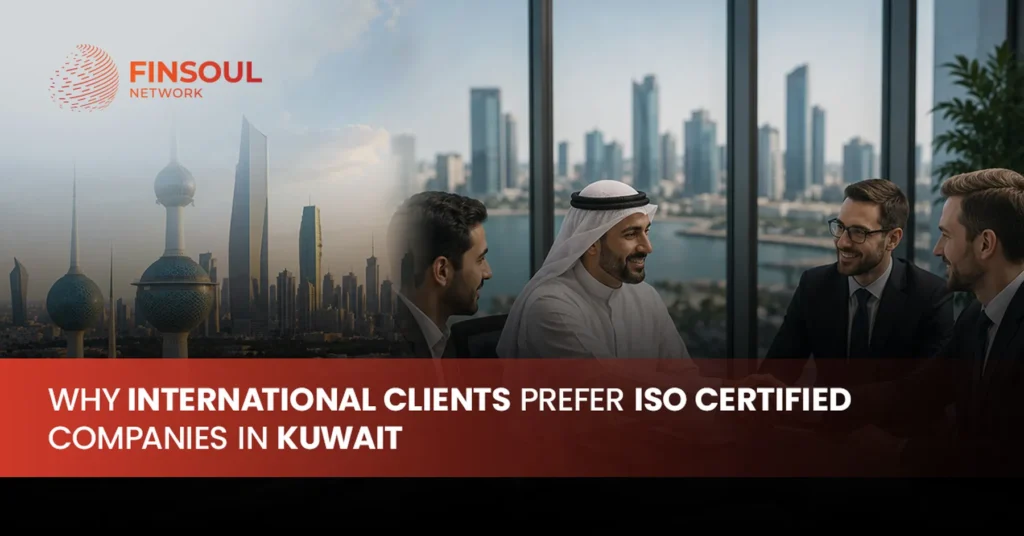
When international clients evaluate potential partners, they need more than a good sales pitch. They need proof that a company can deliver consistent quality, manage risk responsibly, and meet global standards from day one. This is exactly why ISO Certification in Kuwait has become such a powerful differentiator for local businesses looking to expand beyond domestic borders. Finsoul Network Kuwait has seen firsthand how certification opens doors that marketing alone simply can’t, and our clients consistently tell us it’s one of the best investments they’ve made in their growth. This guide explains why global clients specifically look for ISO certified partners and how Kuwaiti businesses can position themselves to win that trust.
Why Do International Clients Look for ISO Certification?
International clients often can’t visit every supplier’s facility or verify every internal process firsthand, especially when working across borders and time zones. ISO certification solves this problem by providing independently verified proof that a company follows recognized, standardized practices. Instead of relying on claims alone, clients can trust that a certified company has passed rigorous audits covering quality, safety, security, or environmental management, depending on the certification held.
How Does ISO Certification Build Trust with Global Customers?
Trust is built through consistency, transparency, and accountability, and ISO certification demonstrates all three. A certified company has documented processes that don’t depend on one key employee or a single point of failure. This predictability reassures international clients that quality won’t fluctuate based on staffing changes or informal shortcuts. Certification also signals that a business welcomes external scrutiny, which itself builds confidence with clients who value transparency over unverified promises.
Why Is ISO Certification Important for Kuwait Businesses Working Internationally?
Kuwaiti businesses expanding into international markets often compete against companies from regions where certification is already the norm. Without it, local businesses risk being overlooked during vendor evaluations, even if their actual product or service quality is excellent. ISO Certification in Kuwait helps level the playing field, giving local companies a recognized credential that speaks the same language as international procurement teams, regardless of where the business is based.
How ISO Certification Helps Companies Meet Global Quality Standards
ISO standards are designed to be internationally consistent, meaning a certified company in Kuwait follows the same core requirements as a certified company anywhere else in the world. This consistency matters enormously to international clients who need assurance that quality won’t vary depending on geography. A documented Quality Management System, for example, ensures that processes are repeatable and measurable, giving clients confidence that outcomes will remain stable across every order or project.
Which ISO Certifications Matter Most to International Clients?
Certain ISO standards carry particular weight with global clients, depending on the industry and nature of the partnership.
ISO 9001 for Quality Management
As the most widely recognized quality standard globally, ISO 9001 Certification in Kuwait is often the first credential international clients look for. It signals a structured approach to consistent product and service delivery.
ISO 14001 for Environmental Responsibility
Many international buyers, especially in Europe and North America, now factor environmental responsibility into vendor selection. This certification demonstrates a genuine commitment to sustainable operations.
ISO 45001 for Workplace Safety
Clients working in construction, manufacturing, or logistics often prioritize partners with strong occupational safety records, making this certification particularly valuable for companies in those sectors.
ISO 27001 for Information Security
As data breaches become more costly and common, international clients increasingly require proof of strong information security practices before sharing sensitive business data.
ISO 22000 for Food Safety
Companies in food production or export rely on this certification to reassure international buyers that products meet strict safety and handling standards throughout the supply chain.
ISO 50001 for Energy Management
Energy-conscious international clients, particularly in industries with sustainability commitments, often favor suppliers who can demonstrate structured energy management practices.
How Does ISO Certification Improve Business Reputation?
Certification acts as a visible, third-party endorsement of a company’s capabilities, something marketing materials alone can’t replicate. It signals to the broader market, including competitors, partners, and potential clients, that the business meets internationally recognized benchmarks. Over time, this reputation compounds, making certified companies more likely to be recommended, referred, and prioritized in industries where trust and reliability directly affect purchasing decisions.
Can ISO Certification Help Kuwait Companies Win International Contracts?
Yes, and in many industries it’s becoming a baseline requirement rather than a bonus. Government tenders, corporate supply chains, and international partnerships increasingly list ISO certification as a mandatory qualification criterion. Companies without it may be automatically disqualified from consideration, regardless of their actual capabilities. Holding the right certifications means Kuwaiti businesses can compete for contracts that would otherwise be out of reach, opening doors to larger, more stable international relationships.
How ISO Certification Supports Compliance and Risk Management
International partnerships often come with complex regulatory and contractual obligations. ISO certification provides a structured framework for managing these risks, from data protection requirements to safety regulations across different markets. This reduces the likelihood of costly compliance failures and gives international clients confidence that their Kuwaiti partner can navigate cross-border requirements without unnecessary risk to either party.
What Business Advantages Come from ISO Certification in Kuwait?
Beyond winning contracts, certification often improves internal operations through better documentation, clearer accountability, and more consistent processes. These improvements tend to reduce errors, rework, and inefficiencies, which directly benefits profitability. Certified companies also often find it easier to attract skilled employees and long-term business partners who prefer working with organizations that demonstrate genuine operational maturity.
How Can Companies in Kuwait Become ISO Certified?
The certification process typically begins with a gap analysis comparing current operations against the relevant standard’s requirements. From there, businesses update policies, train staff, and implement the necessary documentation before undergoing an internal audit. A certification body then conducts the official audit, and upon successful completion, issues the certification. Ongoing surveillance audits, usually annual, ensure continued compliance over time.
Choose the Right ISO Certification Partner in Kuwait
Working with an experienced iso consultant kuwait businesses trust, such as the team at Finsoul Network Kuwait, can significantly simplify this process, particularly for companies pursuing multiple certifications or navigating industry-specific requirements for the first time. A good consultant not only prepares documentation but also helps identify which certifications will have the greatest impact on ISO Certification for International Clients specifically, rather than pursuing standards that don’t align with target markets.
Conclusion: Build Global Trust with ISO Certification in Kuwait
International clients don’t just want a good product or service, they want proof that a business can consistently deliver it, manage risk responsibly, and meet global expectations without constant oversight. ISO Certification in Kuwait provides exactly that proof, giving local businesses a credible, internationally recognized way to build trust before a single conversation even begins. We help businesses across Kuwait identify the right certifications, prepare for audits, and position themselves competitively for international partnerships. If you’re ready to build the kind of trust that wins global contracts, Finsoul Network Kuwait is here to guide you through every step of the certification journey.
Office Address: Al Hamra Tower & Mall, 159 Street 35th, Kuwait City, Kuwait
Email Address: info@isoconsultancykuwait.com
Frequently Asked Questions
Do international clients always require ISO certification before signing a contract?
Not always, but it’s increasingly common, especially in industries like manufacturing, food production, and technology, where certification has become a standard vendor evaluation criterion.
Which ISO certification should a company get first if targeting international clients?
ISO 9001 is typically the best starting point, since it’s the most widely recognized quality standard globally and often expected as a baseline before other industry-specific certifications are considered.
How long does it take to get ISO certified in Kuwait?
Timelines vary by standard and company size, but most certifications take between three and six months from initial gap analysis to final audit, sometimes longer for multiple certifications pursued together.
Is ISO certification only useful for large companies pursuing international clients?
No. Small and medium-sized businesses benefit just as much, since certification helps them compete for contracts and partnerships that might otherwise favor larger, already-certified competitors.
Do certifications need to be renewed?
Yes. ISO certifications typically require annual surveillance audits and a full recertification audit every three years to confirm continued compliance with the standard.