
ISO Certification for Oil and Gas Industry in Kuwait
Kuwait’s energy sector continues to expand as oil and gas companies upgrade operations, strengthen safety systems, and meet rising global compliance expectations. With major upstream, midstream, and downstream projects underway, organisations must follow internationally recognised standards to protect workers, reduce risks, and maintain operational reliability.
Many companies now adopt iso certification for oil and gas industry requirements to improve performance, environmental responsibility, and regulatory alignment. Finsoul Network Kuwait supports operators, contractors, engineering firms, and service providers in developing certification‑ready management systems that improve efficiency, ensure compliance, and reinforce credibility across Kuwait’s highly regulated oil and gas landscape.
ISO Certification for Oil and Gas Industry in Kuwait
Kuwait’s oil and gas market remains the dominant force in the national economy, contributing over 90 percent of government revenues and approximately 40 percent of GDP. Kuwait Petroleum Corporation and its subsidiaries continue to invest heavily in upstream capacity expansion, refinery modernisation, and petrochemical development to maximise the value of Kuwait’s hydrocarbon resources. ISO certification has become a fundamental requirement for all contractors, service providers, and suppliers seeking to work with KPC, KOC, KNPC, and other national energy entities.
The market is further driven by growing demand for cleaner energy production, increasing focus on operational efficiency, and rising expectations around environmental performance and worker safety. Contractors and service companies that invest in structured quality, safety, and environmental management systems through iso certification for oil and gas consistently win more tenders, reduce operational incidents, and demonstrate the technical credibility required by Kuwait’s national oil companies. Finsoul Network Kuwait partners with oil and gas businesses of all sizes to implement the right certification frameworks for their specific operational scopes and contract requirements.
Major Segments of Kuwait's Oil and Gas Industry
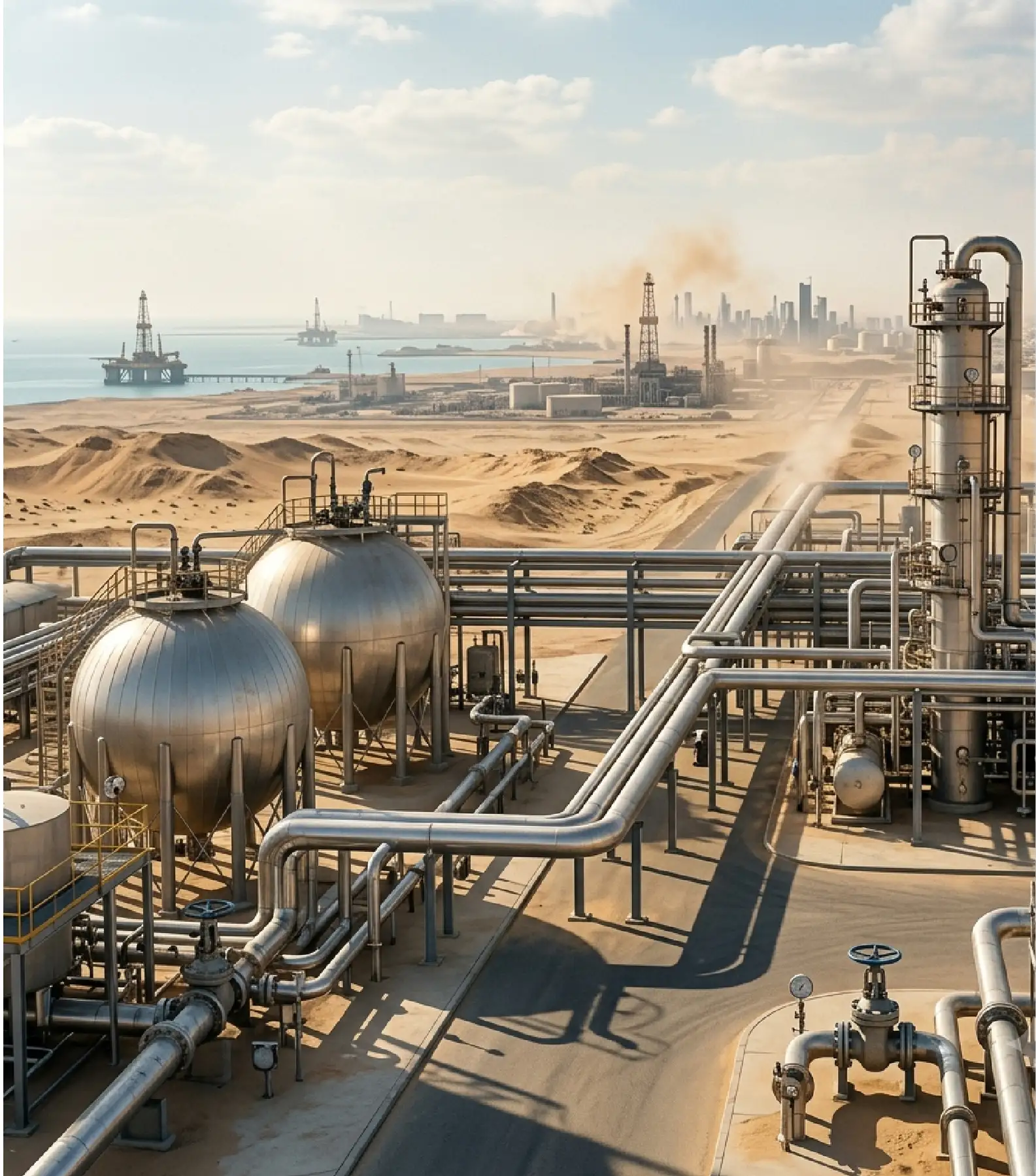
Kuwait’s oil and gas sector spans a comprehensive range of upstream, midstream, and downstream activities, each contributing to the country’s hydrocarbon value chain and economic output.
Upstream Exploration and Production
Kuwait Oil Company leads upstream exploration, drilling, and production operations across Kuwait’s onshore and offshore fields. This segment demands the most rigorous safety and quality management systems, making ISO certification for the oil and gas industry a baseline operational requirement for all participating contractors and service providers.
Refining and Downstream Operations
Kuwait National Petroleum Company operates three major refineries at Mina Al-Ahmadi, Mina Abdullah, and Shuaiba. Refinery operations require strict process safety management, environmental compliance, and quality control systems aligned with iso certification for oil and gas companies’ standards across all operational areas.
Petrochemical Manufacturing
Petrochemical Industries Company produces fertilisers, industrial chemicals, and petrochemical derivatives for domestic and export markets. Petrochemical facilities require comprehensive quality, safety, and environmental management systems to manage complex chemical processes and hazardous material handling safely.
Oilfield Services and Technical Contracting
A large ecosystem of oilfield service companies, engineering contractors, and technical specialists supports Kuwait’s upstream and downstream operations. These businesses must hold recognised iso certification for oil and gas services credentials to qualify for KOC and KNPC vendor lists and project tenders.
LNG, Gas Processing, and Energy Infrastructure
Kuwait’s gas processing and liquefied natural gas infrastructure supports both domestic energy supply and export operations. Gas processing facilities require rigorous process safety, equipment integrity, and environmental management systems aligned with international oil and gas standards.
How Kuwait's Oil and Gas Industry Operates
Kuwait’s oil and gas sector follows a highly structured operational framework covering exploration, production, processing, and distribution activities across the entire hydrocarbon value chain.
| Stage | Description |
|---|---|
Exploration and Reservoir Assessment |
Geological surveys, seismic data analysis, and exploratory drilling are conducted to identify and evaluate hydrocarbon reservoirs. Technical quality management systems aligned with ISO certification for oil and gas industry govern data integrity and operational safety during exploration activities. |
Drilling and Well Construction |
Drilling contractors design and construct oil and gas wells according to engineering specifications, regulatory requirements, and safety management systems. Blowout prevention, well integrity, and personnel safety are critical operational priorities at this stage. |
Production and Field Operations |
Produced hydrocarbons are extracted, separated, treated, and transported from wellheads to processing facilities. Production operations require continuous monitoring, equipment maintenance, and environmental management to meet operational and regulatory requirements. |
Refining, Processing, and Product Separation |
Crude oil and gas are processed in refineries and gas plants to produce refined petroleum products, LPG, natural gas, and petrochemical feedstocks. Process safety management and quality control systems are critical throughout all refining operations. |
Storage, Transportation, and Export |
Finished petroleum products and crude oil are stored and transported through pipelines, tankers, and terminal facilities to domestic consumers and international export markets. Logistics quality and safety management systems govern all storage and transportation operations. |
Regulatory and Compliance Framework for Oil and Gas in Kuwait
Kuwait’s oil and gas industry operates within a rigorous and multi-layered regulatory environment governed by national authorities and international standards bodies. Compliance with these frameworks is mandatory for all businesses operating in the sector. We help organisations navigate these requirements through structured ISO certification for oil and gas industry consultation and support.
Kuwait Petroleum Corporation (KPC)
KPC is the national holding company overseeing all of Kuwait’s oil and gas operations through its subsidiaries. KPC sets the overarching strategic direction, corporate governance standards, and contractor qualification requirements across the entire Kuwaiti hydrocarbon sector.
Kuwait Oil Company (KOC)
KOC manages upstream exploration and production operations and maintains strict vendor qualification and contractor management requirements. All companies seeking to work with KOC must demonstrate compliance with quality, safety, and environmental standards through recognised ISO certification for oil and gas companies credentials.
Kuwait National Petroleum Company (KNPC)
KNPC oversees refinery operations and downstream petroleum product distribution. KNPC’s contractor and supplier qualification processes require businesses to hold relevant ISO certifications as a mandatory prequalification condition for all significant contracts and service agreements.
Environment Public Authority (EPA)
The EPA regulates environmental performance across Kuwait’s industrial sectors, including oil and gas. Iso certification for oil and gas services providers helps businesses build the environmental management systems needed to meet EPA requirements and demonstrate responsible operational practices.
Standards and Best Practices in Kuwait's Oil and Gas Industry
Oil and gas businesses in Kuwait are expected to align with internationally recognised management standards and industry-specific technical frameworks. These standards improve operational safety, environmental performance, and quality consistency across all activities. Iso 29001 certification QMS for oil and gas industry provides the most directly applicable quality management framework for hydrocarbon sector businesses.
ISO 29001 — Quality Management for Oil and Gas
ISO 29001 is the petroleum, petrochemical, and natural gas industry-specific quality management standard. Built on ISO 9001 foundations, it adds sector-specific requirements for product and service quality management. It is the primary quality standard required by Kuwait’s national oil companies from their contractors and suppliers.
ISO 45001 — Occupational Health and Safety
Oil and gas operations carry some of the highest workplace safety risks of any industry. ISO 45001 provides a comprehensive framework for hazard identification, risk assessment, incident prevention, and emergency response management across all upstream and downstream operational environments.
ISO 14001 — Environmental Management System
Environmental performance is under intense scrutiny in the oil and gas sector. ISO 14001 helps oil and gas businesses manage emissions, spill prevention, waste management, and environmental monitoring in line with EPA requirements and international environmental expectations for the hydrocarbon industry.
API Standards and Process Safety Management
American Petroleum Institute standards and process safety management frameworks complement ISO certifications for oil and gas operations. Together they provide a comprehensive technical and management system framework for safe and efficient hydrocarbon operations across all operational segments.
Challenges Facing the Oil and Gas Industry in Kuwait
Kuwait’s oil and gas sector faces a range of technical, operational, environmental, and market challenges that require strategic management and robust operational frameworks.
- Ageing Field Infrastructure and Reservoir Management: Many of Kuwait’s producing oil fields have been in operation for decades. Managing ageing infrastructure, maintaining well productivity, and optimising reservoir recovery rates require significant technical investment and rigorous asset integrity management systems.
- Process Safety and Major Accident Prevention: Oil and gas operations carry inherent major accident hazard risks including fires, explosions, and toxic releases. Implementing and maintaining robust process safety management systems across all facilities is a continuous and demanding operational challenge for the sector.
- Environmental Performance and Carbon Management: Growing global pressure to reduce the carbon footprint of oil and gas operations is creating significant compliance and investment challenges. Managing flaring, emissions, water disposal, and environmental impact requires increasingly sophisticated management systems and technologies.
- Contractor and Supply Chain Management Complexity: Kuwait’s oil and gas projects involve large and complex contractor ecosystems. Managing contractor qualification, performance monitoring, and safety compliance across hundreds of service providers requires disciplined vendor management and quality assurance systems.
- Workforce Nationalisation and Skill Development: Kuwait’s Kuwaitisation targets require national oil companies and their contractors to progressively increase Kuwaiti workforce participation. Balancing nationalisation requirements with the need for specialised technical skills is an ongoing human resources challenge across the sector.
Opportunities in Kuwait's Oil and Gas Industry
Kuwait’s oil and gas sector offers significant business development and growth opportunities for well-qualified and properly certified companies operating across the hydrocarbon value chain.
- KOC Upstream Capacity Expansion Projects: Kuwait Oil Company’s ambitious production capacity expansion programme is generating substantial contracting and service opportunities across drilling, engineering, construction, and operations management.
- KNPC Refinery Modernisation and Clean Fuels Projects: KNPC’s ongoing refinery upgrade and clean fuels production projects represent multi-billion-dollar investment programmes. Contractors and equipment suppliers with recognised ISO certification for oil and gas industry credentials are strongly positioned to participate in these high-value project opportunities.
- Oilfield Services Market Growth: Growing drilling activity and production optimisation programmes are driving demand for specialised oilfield services across Kuwait. Service companies holding iso 29001 certification QMS for oil and gas industry and other relevant standards gain clear advantages in KOC and KNPC vendor qualification processes.
- Digital Oilfield and Technology Services: Kuwait’s national oil companies are investing heavily in digital transformation, smart field technologies, and data analytics. Technology service providers with quality management certifications are well-positioned to capture growing demand for digital oilfield solutions and services.
- Petrochemical Sector Expansion: PIC and associated entities are pursuing petrochemical capacity expansion to increase the value extracted from Kuwait’s hydrocarbon resources. This creates new opportunities for engineering contractors, equipment suppliers, and specialist service providers with appropriate ISO certifications for oil and gas services.

Technology and Innovation in Kuwait's Oil and Gas Industry
Technology is transforming operational efficiency, safety management, and environmental performance across Kuwait’s oil and gas sector.
| Technology | Industry Impact |
|---|---|
Digital Oilfield and Smart Production Systems |
Integrated digital oilfield platforms connect wellhead sensors, production equipment, and control systems to enable real-time production optimisation, remote monitoring, and predictive maintenance aligned with ISO certification for the oil and gas industry management requirements. |
Advanced Process Safety Management Systems |
Digital process safety platforms manage hazard identification studies, safety critical element performance standards, and management of change processes. They support rigorous process safety compliance across Kuwait’s upstream and downstream facilities. |
Drone and Robotic Inspection Technology |
Unmanned aerial and ground-based robotic systems conduct pipeline inspections, tank assessments, and facility surveys in hazardous environments. They improve inspection quality, reduce personnel exposure to risk, and support asset integrity management programmes. |
AI-Powered Predictive Maintenance |
Artificial intelligence and machine learning analyse equipment performance data to predict failures before they occur. This reduces unplanned downtime, extends equipment life, and supports the continuous improvement requirements of iso certification for oil and gas services management systems. |
Environmental Monitoring and Emissions Management Technology |
Advanced emissions monitoring systems track flaring, fugitive emissions, and environmental discharges in real time. They support compliance with EPA requirements and help oil and gas businesses meet the environmental performance expectations of iso 29001 certification QMS for oil and gas industry frameworks. |
Risk Factors in Kuwait's Oil and Gas Industry
Oil and gas businesses in Kuwait must proactively identify and manage a wide range of technical, safety, environmental, and commercial risks to maintain safe, compliant, and profitable operations.
Major Accident and Process Safety Risk:
Fires, explosions, and toxic releases represent the most severe risk category in oil and gas operations. Failure to maintain robust process safety management systems can result in catastrophic consequences for personnel, assets, and the environment.
Environmental Liability and Spill Risk:
Oil spills, gas releases, and contaminated water disposal incidents expose businesses to significant environmental liability, regulatory penalties, and reputational damage. Proactive environmental management through iso certification for oil and gas is essential for managing this risk.
Oil Price Volatility and Revenue Risk:
Kuwait’s economy and oil and gas investment programmes are sensitive to global oil price movements. Price downturns can trigger project deferrals, budget cuts, and contract cancellations that significantly impact service company revenues and business continuity.
Contractor Non-Compliance and Performance Risk:
Large contractor ecosystems create exposure to substandard safety practices, quality failures, and regulatory non-compliance. Robust contractor management systems and mandatory iso certification for the oil and gas companies’ requirements help mitigate this critical operational risk.
Cybersecurity and Operational Technology Risk:
Oil and gas operational technology systems are increasingly connected and exposed to cyber threats. A successful cyberattack on production control systems or refinery operations could cause safety incidents, production losses, and significant financial and reputational damage.
Future Outlook for Kuwait's Oil and Gas Industry
Kuwait’s oil and gas industry is entering a pivotal period of sustained investment, technological transformation, and evolving operational standards. Government commitment to production capacity expansion, refinery modernisation, and petrochemical development will drive strong activity levels across the sector for the foreseeable future. At the same time, growing environmental expectations, digital transformation imperatives, and increasing contractor qualification standards will raise the bar for businesses operating across the hydrocarbon value chain.
The adoption of ISO certification for the oil and gas industry will become increasingly universal as Kuwait’s national oil companies tighten their vendor qualification requirements and align more closely with international industry best practices. Finsoul Network Kuwait is positioned to support this evolution by helping oil and gas businesses build the management systems they need to compete, comply, and perform at the highest levels in Kuwait’s demanding energy sector.
Note: The above-mentioned services are provided via network firms if not provided directly
Economic Contribution of Kuwait's Oil and Gas Industry
Kuwait’s oil and gas industry is the backbone of the national economy, contributing the vast majority of government revenues, export earnings, and GDP output. The sector directly employs tens of thousands of Kuwaiti and expatriate professionals across engineering, operations, maintenance, and support functions while sustaining hundreds of thousands of indirect jobs across contracting, logistics, manufacturing, and professional services. Oil and gas revenues fund Kuwait’s public infrastructure, healthcare, education, and social welfare systems, making the sector the fundamental enabler of the country’s prosperity and development.
As Kuwait pursues economic diversification under Vision 2035, the oil and gas sector will remain the primary financial engine supporting national transformation. Finsoul Network Kuwait is proud to support this vital industry by delivering expert ISO certification for the oil and gas industry services that help businesses build world-class management systems, meet international standards, and contribute to Kuwait’s energy future with confidence and excellence.
Build Safer, Compliant Oil and Gas Operations with ISO Certification
Achieve ISO Certification for Oil and Gas Industry with expert support from Finsoul Network Kuwait. We help contractors, operators, and service providers improve safety, quality, environmental compliance through internationally recognised standards, ensuring operational excellence regulatory approval successfully.
FAQs
What is ISO certification for oil & gas services?
ISO certification for oil & gas is a formal recognition that service providers in the energy sector follow internationally accepted standards for quality, safety, and environmental management. It ensures consistent service delivery across drilling, maintenance, logistics, and support operations.
Which ISO certifications do oil and gas contractors need in Kuwait?
ISO 29001, ISO 45001, and ISO 14001 are the most widely required. Iso certification for oil and gas companies typically pursues all three as a combined package to meet KOC and KNPC prequalification requirements comprehensively.
Why do companies need ISO certification providers for oil and gas in Kuwait?
Companies need ISO certification providers for oil and gas in Kuwait to ensure they meet strict industry requirements, reduce operational risks, improve safety performance, and qualify for contracts with national and international oil and gas operators.
What is ISO 29001 certification QMS for oil & gas industry?
ISO 29001 certification QMS for oil & gas industry is a specialized Quality Management System standard designed specifically for petroleum, petrochemical, and natural gas sectors. It focuses on improving product and service quality while reducing operational risks across the supply chain.
Does ISO certification guarantee inclusion on KOC or KNPC vendor lists?
ISO certification is a mandatory prequalification requirement but not the sole qualification criterion. However, ISO certification for oil and gas industry is an essential first step that no contractor or supplier can progress without in Kuwait’s national oil company procurement processes.