
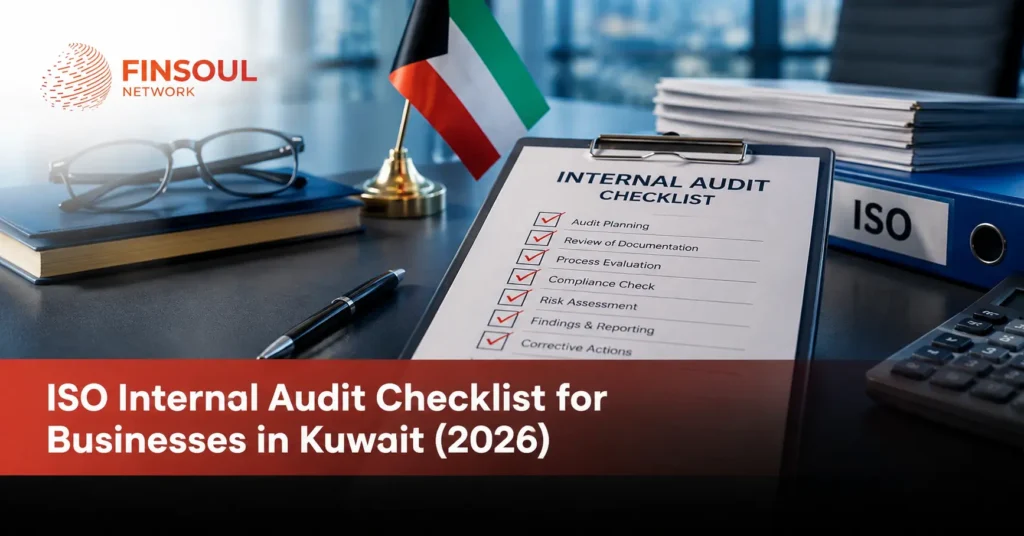
Running a business in Kuwait today means more than just delivering good products or services. It means proving it through structured systems, documented processes, and verified compliance. That is exactly where the ISO internal audit comes in. Whether you are a food manufacturer, an IT firm, or a logistics company, conducting a proper ISO internal audit helps you stay ahead of risks, maintain certification, and build lasting trust with your clients and regulators.
This blog walks you through a practical ISO internal audit checklist for businesses operating in Kuwait in 2026, covering the most relevant standards and what you need to check at every stage.
What Is an ISO Internal Audit and Why Does It Matter?
An ISO internal audit is a systematic, independent, and documented process used to evaluate how well your organization’s management system conforms to ISO requirements. It is not a one-time event. It is an ongoing cycle of review, correction, and improvement.
For businesses in Kuwait, internal audits are not just a formality. They are a requirement for maintaining ISO certification in Kuwait and demonstrating operational excellence to government bodies, clients, and international partners. Whether you hold ISO 9001, ISO 27001, or ISO 22000 certification, you must conduct regular internal audits to keep your certificate valid.
Finsoul Network Kuwait helps businesses across industries design and execute internal audit programs that are practical, compliant, and aligned with current ISO standards.
Key ISO Standards Covered in This Checklist:
Before diving into the checklist, let us clarify which standards this guide addresses:
- ISO 9001 Quality Management System (QMS)
- ISO 27001 Information Security Management System (ISMS)
- ISO 22000 Food Safety Management System (FSMS)
Each standard has its own audit requirements, but they all share a common structure based on the Plan-Do-Check-Act (PDCA) cycle and risk-based thinking.
General ISO Internal Audit Checklist (Applicable to All Standards):
This section applies to any ISO management system. Use it as your starting baseline before moving to standard-specific checks.
Audit Planning and Scope:
Ensure the audit program is documented and formally approved. Verify that audit scope, criteria, and objectives are clearly established. Confirm auditors are competent and independent of audited areas. Check that audit frequency is determined based on process importance and previous audit outcomes.
Documentation Review:
Review the organization’s quality or safety manual to ensure it reflects current operational requirements. Confirm that all required procedures and records are updated, maintained, and properly controlled. Verify that document control procedures are consistently followed. Check that obsolete documents are removed or clearly marked to prevent unintended use.
Management Commitment:
Review evidence of top management involvement in the management system to ensure leadership support and accountability. Confirm that policy statements are communicated and understood by staff. Verify that management review meetings are conducted regularly and documented appropriately.
Objectives and Performance Monitoring:
Confirm that measurable objectives are established and monitored to evaluate performance. Review KPI data and performance reports to assess progress. Check that corrective actions are initiated whenever targets are not achieved.
Corrective Actions and Nonconformities:
Review the nonconformity log to ensure issues are properly recorded. Confirm that root cause analysis has been completed for each nonconformity. Verify that corrective actions are implemented within agreed timelines and evaluated for effectiveness.
Internal Audit Records:
Ensure all previous audit reports are properly maintained and accessible for reference. Confirm that audit findings are communicated to relevant teams. Verify that follow-up audits are conducted where necessary to confirm closure of findings.
ISO 9001 Internal Audit Checklist:
The iso 9001 internal audit focuses on the organization’s ability to consistently provide products and services that meet customer and regulatory requirements.
Context of the Organization
- Has the organization identified internal and external issues that affect its QMS?
- Are the interested parties and their needs documented?
- Is the scope of the QMS clearly defined?
Customer Focus
Confirm that customer requirements are captured, reviewed, and validated before accepting orders to ensure the organization can meet expectations. Verify that customer satisfaction is measured through appropriate feedback mechanisms and performance evaluation methods. Ensure customer complaints are managed through a documented process that supports timely resolution and continuous improvement.
Supplier and Procurement Controls
Verify that approved supplier lists are maintained, periodically reviewed, and updated as necessary. Confirm that purchased goods and services are inspected or verified before use to ensure compliance with requirements. Review supplier performance records to evaluate reliability and support supplier management decisions.
Product and Service Delivery
Ensure work instructions are available at the point of use and accessible to relevant personnel. Confirm that product traceability is maintained throughout applicable stages of the process. Verify that monitoring and measuring resources are calibrated, maintained, and suitable for intended use.
Nonconforming Outputs
Confirm that a documented process exists for identifying, segregating, and controlling nonconforming products or outputs. Verify that disposition decisions are properly documented and authorized. Ensure that rework or re-inspection activities are performed where required and appropriate records are maintained.
For businesses seeking ISO Certification in Kuwait under the 9001 standard, this checklist helps identify gaps and improve readiness before the external certification audit.
ISMS ISO 27001 Audit Checklist:
Information security is one of the fastest-growing areas of compliance in Kuwait, especially as businesses digitize their operations. The isms iso 27001 audit checklist covers the key controls that protect your data assets.
Information Security Policies
Verify that a documented information security policy exists and has been formally approved by management. Confirm that the policy is reviewed at planned intervals and updated following significant organizational, operational, or regulatory changes to ensure continued relevance and effectiveness.
Asset Management
Ensure that an inventory of information assets is maintained and regularly updated. Verify that assets are classified according to their sensitivity, value, and criticality to the organization. Confirm that ownership responsibilities and handling requirements are clearly assigned for each asset.
Access Control
Review whether user access rights are granted according to business requirements and the principle of least privilege. Confirm that formal procedures exist for provisioning, modifying, and revoking user access. Verify that privileged accounts are monitored and periodically reviewed to maintain security controls.
Risk Assessment and Treatment
Confirm that information security risk assessments are documented, current, and aligned with organizational requirements. Verify that a risk treatment plan has been implemented and monitored to address identified risks. Ensure residual risks are formally reviewed and accepted by management where applicable.
Incident Management
Verify that documented procedures are established for reporting, responding to, and managing information security incidents. Confirm that incidents are logged, investigated, tracked, and closed within defined timelines to support corrective action and continual improvement.
Business Continuity
Ensure backup procedures are documented, implemented, and periodically tested for effectiveness. Verify that a business continuity plan or disaster recovery plan exists and is regularly tested to maintain operational resilience during disruptions.
Supplier Relationships
Confirm that information security requirements are incorporated into supplier agreements and contracts. Verify that supplier security performance is monitored and reviewed to ensure continued compliance with organizational and security expectations.
The ISMS ISO 27001 audit checklist is particularly important for IT companies, financial institutions, and businesses handling personal data in Kuwait, helping organizations strengthen security controls and prepare for certification audits.
ISO 22000 Audit Checklist:
The iso 22000 audit checklist is designed for food businesses, manufacturers, caterers, packagers, distributors, and anyone in the food supply chain.
Food Safety Policy and Objectives
Verify that a documented food safety policy is established, approved, and communicated to all employees across the organization. Confirm that food safety objectives are measurable, monitored, and regularly reviewed to support continual improvement and compliance with food safety requirements.
Hazard Analysis and HACCP Plan
Ensure that a comprehensive hazard analysis has been completed covering biological, chemical, and physical hazards across all applicable processes. Verify that Critical Control Points (CCPs) are identified, monitored, and properly documented. Confirm that corrective actions are implemented whenever CCP limits are exceeded and that records are maintained.
Prerequisite Programs (PRPs)
Review whether prerequisite programs are documented and implemented for key operational areas including cleaning and sanitation, pest control, personnel hygiene, and supplier management. Confirm that PRPs are regularly verified and reviewed to ensure ongoing effectiveness.
Traceability
Verify that the organization can trace raw materials through the production process to finished products and backward to suppliers where required. Confirm that traceability records are maintained, accurate, and retrievable within an established timeframe to support product control and recall activities.
Product Release
Ensure that finished products are evaluated and verified against defined food safety requirements prior to release. Confirm that product release records are maintained to demonstrate compliance and support product accountability.
Internal Communication
Verify that food safety information and related issues are effectively communicated across all departments to ensure coordination and compliance with food safety requirements. Confirm that employees receive appropriate training and understand their food safety responsibilities, roles, and reporting obligations within the food safety management system.
Businesses seeking ISO 22000 internal audit training in Kuwait can gain significant value by working with experienced consultants who understand both the requirements of the standard and the local regulatory environment. Combining training with practical audit activities helps organizations strengthen internal capabilities and improve audit effectiveness.
Common Gaps Found During ISO Audits in Kuwait:
Based on typical audit findings across Kuwait businesses, here are the most frequent nonconformities uncovered during an iso audit:
- Objectives are set but not measured or reviewed regularly
- Corrective actions are raised but never verified for effectiveness
- Documented procedures exist, but employees are unaware of them
- Internal auditor competence is not formally assessed or recorded
- Risk assessments are completed once and never updated
Identifying these gaps before your external certification audit is the entire purpose of a well-run ISO internal audit program.
How Finsoul Network Kuwait Supports Your Audit Program:
We provide end-to-end support for businesses preparing for and maintaining ISO certification. From gap analysis to audit planning, checklist development, and internal auditor training, the team brings practical expertise across multiple ISO standards.
Whether you are pursuing a new ISO Certification in Kuwait or maintaining an existing one, having a reliable partner makes the process faster, more accurate, and less stressful for your team.
Conclusion:
A structured ISO internal audit is not just a box-ticking exercise. It is the backbone of any effective management system. For businesses in Kuwait operating under ISO 9001, ISO 27001, or ISO 22000, conducting regular internal audits using a comprehensive checklist helps you catch problems early, demonstrate compliance, and continuously improve.
From the iso 9001 internal audit checklist to the isms iso 27001 audit checklist and the iso 22000 audit checklist, every standard has its own focus areas, but they all share the goal of building a stronger, more reliable organization.
If your business needs expert support, ISO Consultancy Kuwait services are available through experienced teams that understand the local business environment and international certification requirements. Partnering with Finsoul Network Kuwait ensures your internal audit program is not just compliant, it is genuinely useful for your business.
Start your audit program today and turn compliance into a competitive advantage.
Office Address: Al Hamra Tower & Mall, 159 Street 35th, Kuwait City, Kuwait
Email: info@finsoulnetwork.com
FAQs:
How often should ISO internal audits be conducted?
ISO standards require that internal audits be conducted at planned intervals. Most organizations conduct them at least once a year, though high-risk processes or departments may require more frequent audits. The audit frequency should be documented in your audit program and adjusted based on past results and risk levels.
Who can conduct an ISO internal audit?
Internal audits must be conducted by competent individuals who are independent from the area being audited. This means an employee from one department can audit another department. Auditors should be trained in audit techniques and familiar with the relevant ISO standard. You do not have to hire an external auditor for internal audits.
What is the difference between an internal audit and an external certification audit?
An ISO internal audit is conducted by or on behalf of your organization for internal purposes. An external certification audit is carried out by an accredited certification body to assess whether your organization meets the requirements of the ISO standard. Internal audits help you prepare for external ones.
What happens if nonconformities are found during an internal audit?
Nonconformities must be documented, investigated for root cause, and addressed through corrective actions. The corrective actions must then be verified to ensure they have been effectively implemented. Unresolved nonconformities from internal audits can become major findings in external certification audits.
Is ISO internal audit training mandatory for businesses in Kuwait?
While there is no Kuwait-specific law requiring ISO internal audit training, maintaining ISO certification requires that internal auditors be competent. Most certification bodies will check auditor qualifications during external audits. Investing in iso 22000 internal audit training in Kuwait or iso 9001 internal audit training is therefore practically necessary, not just recommended.