
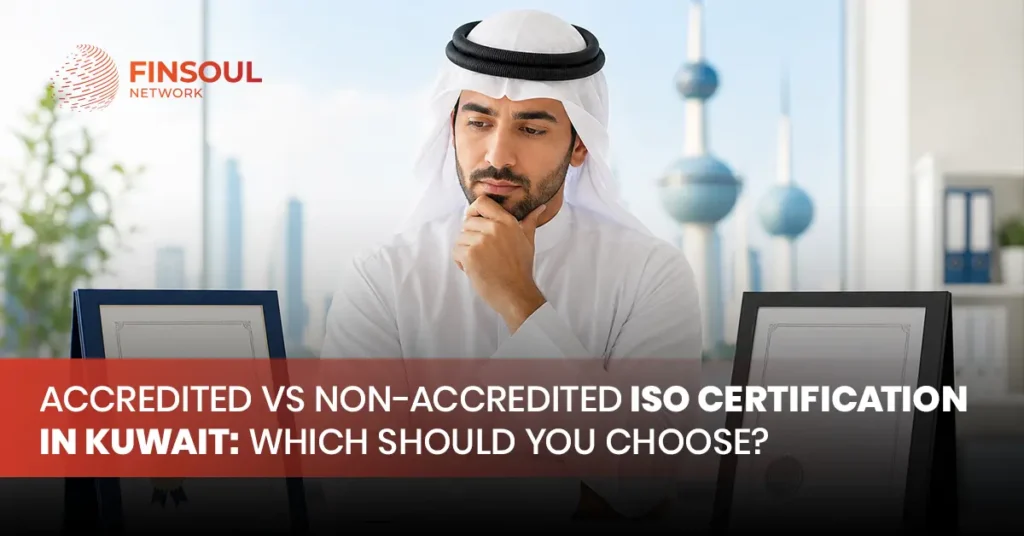
The difference between an accredited and non-accredited ISO certificate can affect whether customers, tendering organizations, and business partners accept it. Although both may refer to the same international standard, the certification body behind the document may have undergone a different level of independent assessment.
For businesses considering ISO certification in Kuwait, the decision should depend on why the certificate is needed. A company preparing for a government tender may face different requirements from one seeking to improve its internal processes. Finsoul Network Kuwait supports businesses with ISO consultancy, management system implementation, and certification preparation, helping them understand the requirements before approaching an independent certification body. Knowing how accreditation works can help companies make an informed decision and avoid paying for a certificate that does not meet their requirements.
What Is the Difference Between Accredited and Non-Accredited Certification?
Certification and accreditation are related, but they are not the same.
Certification is an independent assessment of whether an organization’s management system meets the requirements of a particular standard, such as ISO 9001 for quality management or ISO 14001 for environmental management.
Accreditation is an assessment of the certification body itself. An accreditation body evaluates whether the organization conducting certification has the competence, impartiality, and procedures required for its work. For management system certification, the relevant international requirements are set out in ISO/IEC 17021-1.
A non-accredited certification body issues certificates without holding accreditation for the relevant certification activity and scope. This does not automatically mean that the provider is dishonest or that its auditors lack experience. However, its competence has not received the same formal independent confirmation through an accreditation process.
One point often causes confusion: ISO does not issue certificates or approve certification companies. ISO develops international standards. Independent certification bodies audit organisations, while accreditation bodies assess those certification bodies. The phrase iso accreditation is sometimes used in business discussions, but it is important to understand that accreditation applies to the certification body, not to ISO itself.
How Does Accreditation Affect ISO Certification in Kuwait?
For a company seeking ISO Certification in Kuwait, accreditation can influence how external organizations assess its certificate. Some customers accept certificates from non-accredited providers, while others specify that certification must come from a body accredited for the relevant standard.
This distinction matters in procurement, supplier approval, and international business relationships. A certificate may demonstrate that a company has established a management system, but it may not meet a tender condition if the buyer specifically requires accredited certification.
Accreditation is not automatically a legal requirement for every Kuwaiti business. Its importance depends on the industry, contract, customer, and purpose of certification. Businesses should review the relevant tender documents or ask the organization requesting the certificate to confirm its requirements.
Kuwait’s Public Authority for Industry (PAI) has an industrial standards and services sector that includes accreditation management. Its published responsibilities include coordinating with national and international accreditation bodies, registering conformity assessment bodies operating in Kuwait, and monitoring the validity and scope of accreditation certificates. This makes it a relevant national reference when checking the local accreditation framework.
Main Advantages of Accredited ISO Certification
Independent Assessment of the Certification Body
An accredited certification body has undergone an external assessment of its competence and impartiality. The assessment considers whether it has suitable auditors and documented procedures and controls for the certification activities included in its scope. This provides an additional level of assurance beyond the audit of the company applying for certification.
Greater Confidence Among Customers and Buyers
Procurement teams and major customers may prefer accredited certificates because the issuing body has been independently assessed. This can be particularly relevant when a company supplies larger organizations, participates in formal tenders, or works with international buyers.
However, accreditation does not guarantee that every customer or regulator will accept a certificate. The buyer’s own requirements still need to be checked.
Easier Verification
A recognized accreditation framework gives customers a way to check the certification body’s status and scope. Businesses should still verify the individual certificate, including the company name, covered locations, activities, standard, and validity.
A logo on a document is not sufficient evidence by itself. The accreditation must cover the specific standard and certification activity stated on the certificate. Understanding the relationship between quality and accreditation helps businesses distinguish a well-run management system from independent confirmation of the certification body’s competence.
When Might Non-Accredited Certification Be Suitable?
Non-accredited certification may be considered when a business wants an external assessment for internal improvement and does not need the certificate to satisfy a tender, regulator or contractual requirement.
For example, a small service company may want an independent review of its quality management procedures to identify weaknesses and improve consistency. If no customer requires accredited certification, it may compare providers based on audit quality, auditor competence, experience with the relevant standard and the usefulness of their findings.
Nevertheless, a company should not assume that a lower-cost certificate will be accepted by future customers. Before selecting a non-accredited provider, ask the organization that will rely on the certificate to confirm its acceptance in writing.
A provider should also explain how it plans audits, records findings, checks corrective actions and manages complaints. A certificate issued without a meaningful assessment offers little evidence that the management system is working.
How to Verify an Accredited Certification Body
Before signing an agreement, carry out the following checks:
- Confirm the issuing organization. Obtain the full legal name of the certification body. Do not rely only on a consultant’s trading name or a sales representative’s details.
- Identify its accreditation body. Ask which organization granted its accreditation and check whether that organization participates in the relevant international recognition arrangement.
- Review the accreditation scope. Confirm that the scope covers management system certification and the exact standard you need, such as ISO 9001, ISO 14001, or ISO 45001.
- Check the certificate details. Verify the certificate number, company name, locations, activities, issue date, and current status with the issuing body.
- Understand the audit process. Ask about audit stages, surveillance visits, nonconformities, corrective actions, complaints, and recertification.
The Global Accreditation Cooperation Incorporated (Global ACI) became operational on 1 January 2026, taking over the former roles of the International Accreditation Forum (IAF) and the International Laboratory Accreditation Cooperation (ILAC). Its Multilateral Recognition Arrangement supports recognition between participating accreditation bodies within the relevant scopes. Not every Global ACI member is an MRA signatory, so membership alone should not be treated as proof of international recognition.
Which Option Should Businesses in Kuwait Choose?
The right choice depends on the intended use of the certificate.
| Business requirement | Recommended approach |
| A tender expressly requires accredited certification | Select a body accredited for the relevant standard and scope |
| An international customer requests recognised certification | Confirm the buyer’s acceptance criteria and choose an appropriately accredited body |
| Certification is for internal improvement | Compare audit quality and cost; accreditation may not be essential |
| A regulator specifies a particular certification route | Follow the regulator’s current requirements |
Before choosing ISO Certification in Kuwait, businesses should establish whether the certificate will be used for a tender, supplier approval, customer assurance, or internal improvement. Each purpose may involve different acceptance criteria.
For most businesses seeking external recognition, accredited certification is generally the safer option. It offers independent assurance about the certification body’s competence, particularly where contracts and procurement requirements are involved.
The business should also select a standard that fits its actual operations. ISO 9001 concerns quality management, ISO 14001 covers environmental management, ISO 45001 addresses occupational health and safety, and ISO/IEC 27001 relates to information security management. Choosing a standard simply because it is popular may lead to unnecessary work without addressing the company’s real requirements.
Finding ISO Certification Support in Jahra
Companies based in Jahra should apply the same checks as businesses elsewhere in Kuwait. A local consultant may help review existing procedures, prepare employees for an audit, and organize corrective actions. However, a consultant is not automatically the organization that issues the certificate. Consulting and certification are separate functions, and the certification decision should remain independent.
When comparing ISO consultants jahra, ask whether the consultant works with independent certification bodies, whether any commercial relationship could affect impartiality, and whether your business can choose its own certification provider. If you are looking for ISO certification in Jahra, verify the issuing body’s accreditation status and scope before paying for the audit.
Conclusion
The decision between accredited and non-accredited certification should be based on the purpose of the audit, the requirements of customers, and the competence of the provider. Businesses should check the issuing body’s status, the relevant accreditation scope and the conditions attached to any tender or contract before proceeding. For organizations that need independent external recognition, ISO Certification in Kuwait through an appropriately accredited certification body will usually offer stronger assurance.
Finsoul Network Kuwait supports businesses through ISO consultancy, management system implementation, documentation, and certification preparation. Whether your organization is planning its first ISO Certification in Kuwait or improving an existing management system, professional guidance helps prepare your business for an independent certification audit.
Office Address: Al Hamra Tower & Mall, 159 Street 35th, Kuwait City, Kuwait
Number: +973 3383 2422
Email: info@isoconsultancykuwait.com
Frequently Asked Questions
Is Accredited ISO Certification Mandatory in Kuwait?
Accredited certification is not automatically compulsory for every Kuwaiti business. A tender, customer contract, or sector-specific requirement may make it necessary. Check the conditions that apply to your organization before choosing a provider.
Does ISO Issue ISO Certificates?
No. ISO develops and publishes international standards but does not certify businesses. Independent certification bodies carry out audits and issue certificates.
What Does an Accreditation Certificate Confirm?
An accreditation certificate confirms that a conformity assessment body has been assessed for competence in the activities and scope stated. It does not certify your business. Your organization receives a separate management system certificate if it passes the certification audit.
Can a Non-Accredited Certificate Be Accepted?
Yes, in some circumstances. Acceptance depends on the customer, tendering organization, or other party relying on the certificate. If a contract requires accredited certification, a non-accredited certificate may not meet that condition.
How Can I Check Whether My ISO Certificate Is Recognized?
Check the certification body’s accreditation status, the accreditation scope, and the certificate’s current validity. You can also search the relevant certificate database or contact the issuing and accreditation bodies directly.