
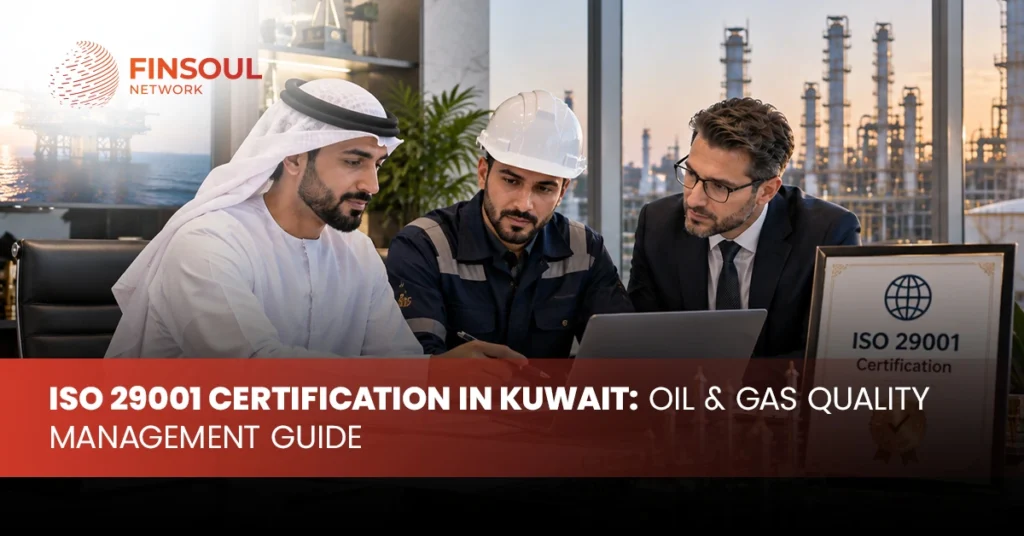
Kuwait’s oil and gas sector depends on reliable suppliers, contractors and service organisations that can deliver consistent quality under demanding technical and operational conditions. For businesses serving this sector, ISO 29001 Certification in Kuwait provides a sector-specific quality management framework designed for organisations supplying products and services to the petroleum, petrochemical and natural gas industries.
For companies seeking stronger quality controls, improved supplier confidence and better readiness for major industry contracts, ISO 29001 can provide a structured approach to risk, operational control, customer requirements and continual improvement. Finsoul Network Kuwait helps organisations prepare their quality management systems and move towards certification with a practical approach.
What is ISO 29001, and Why Does It Matter?
ISO 29001:2020 is a sector-specific quality management standard for product and service supply organisations in the petroleum, petrochemical and natural gas industries. ISO describes it as a supplement to ISO 9001:2015, adding requirements and guidance intended to address risks and opportunities associated with the oil and gas supply chain.
The current standard is ISO 29001:2020, which ISO reviewed and confirmed in 2025. For businesses assessing ISO 29001 Certification in Kuwait, using the current standard is essential. The standard also has Amendment 1:2024, which introduces climate action changes. Organisations planning certification should therefore work against the current applicable version rather than older ISO/TS 29001 editions.
The standard is particularly relevant where quality failures can affect safety, production continuity, equipment reliability, project schedules or contractual performance. It provides a structured basis for controlling processes and demonstrating that quality requirements are understood, implemented and monitored.
How Does ISO 29001 Differ From ISO 9001?
ISO 9001 provides a general quality management framework that can apply across industries. ISO 29001 builds on that foundation for the specific needs of petroleum, petrochemical and natural gas supply organisations.
The difference matters for Kuwait businesses working in oil and gas because their quality systems often need to address industry-specific risks, technical requirements, supply-chain controls and customer expectations. ISO guidance states that ISO 29001 endorses ISO 9001:2015 and adds sector-specific requirements. An organisation conforming to ISO 29001 therefore also meets the certification criteria for ISO 9001.
This does not mean every oil and gas business must replace its existing ISO 9001 system. Instead, organisations can strengthen an established quality management system by incorporating the additional requirements that apply to their activities, products, services and contractual obligations.
Who Should Consider ISO 29001 Certification in Kuwait?
ISO 29001 is particularly relevant for organisations that supply products, equipment or services to the petroleum, petrochemical and natural gas industries. In Kuwait, certification can be valuable for businesses that need to demonstrate consistent quality, controlled processes and the ability to meet demanding customer and contractual requirements. The following types of organisations may benefit most from implementing ISO 29001:
Engineering and Maintenance Contractors
Engineering, maintenance and technical contractors working on oil and gas projects can use ISO 29001 to strengthen process controls, quality assurance and service delivery. A structured quality management system can also help contractors demonstrate their ability to manage project requirements consistently.
Equipment Suppliers and Manufacturers
Manufacturers and suppliers of oil and gas equipment need effective controls over product quality, specifications, procurement and production processes. ISO 29001 can provide a recognised framework for maintaining consistency and reducing quality-related risks across the supply chain.
Inspection and Testing Companies
Inspection, testing and verification providers can benefit from clearly defined processes, documented controls and reliable quality records. These controls are particularly important when inspection results influence equipment acceptance, project quality or operational decisions.
Fabrication and Technical Service Providers
Fabrication companies and specialist technical service providers supporting petroleum and energy projects may use ISO 29001 to improve operational consistency and demonstrate stronger quality management practices to customers and contractors.
Companies Seeking Oil and Gas Contracts
Businesses comparing ISO 29001 certified companies should assess the certification scope, validity and certification-body credentials rather than relying solely on the existence of a certificate. Organisations planning to become ISO 29001 certified should also consider whether their existing quality system and internal processes meet the standard’s sector-specific requirements. For companies participating in tenders or seeking opportunities within Kuwait’s oil and gas supply chain, certification can strengthen their quality credentials. However, businesses should always review individual tender documents, prequalification conditions and customer requirements because ISO certification alone does not guarantee vendor approval or contract awards.
What Are the Main Benefits of ISO 29001 Certification?
A well-implemented quality management system can produce benefits that extend beyond obtaining a certificate. ISO management system guidance links effective systems with more efficient resource use, stronger risk management and the ability to deliver consistent products and services. For Kuwait-based oil and gas suppliers, the main practical benefits can include:
- Better control over operational and quality risks.
- More consistent delivery of products and services.
- Clearer responsibilities, procedures and documented controls.
- Improved monitoring of suppliers and externally provided processes.
- Stronger evidence of conformity with customer requirements.
- Better preparation for internal and external audits.
- A structured approach to corrective action and continual improvement.
- Greater confidence among customers, contractors and other stakeholders.
How Can ISO 29001 Support KOC Contractors?
Kuwait’s energy supply chain includes contractors and suppliers working with major national oil-sector organisations. The Kuwait Oil Company has itself pursued company-wide ISO certification. In June 2025, KOC reported that an external auditor had recommended company-wide certification for both ISO 9001 and ISO 29001.
This development highlights the importance of sector-specific quality management within Kuwait’s oil and gas environment. However, contractors should not assume that ISO certification by itself satisfies every KOC or customer requirement. Contract specifications, approved vendor processes, technical qualifications, HSE requirements and other commercial conditions may apply.
For this reason, ISO certification for KOC contractors should be viewed as part of a broader supplier-readiness strategy. Businesses should map the standard against their contractual requirements, operational controls, technical processes and customer expectations before starting certification.
What Does an ISO 29001 Implementation Process Involve?
Preparing for ISO 29001 Certification in Kuwait normally requires more than creating a quality manual. The organisation needs to establish, implement, maintain and continually improve a quality management system that fits its actual activities. A practical implementation process may include the following stages:
1. Initial Gap Assessment
The organisation reviews its existing quality management system against ISO 29001 requirements. This identifies missing controls, documentation gaps, weak processes and areas requiring improvement.
2. Scope Definition
The business establishes which products, services, locations and activities fall within the management system. The scope should accurately reflect what the organisation does and what it supplies to customers.
3. Process and Risk Review
Key operational processes are mapped and relevant quality risks are assessed. The organisation then establishes controls that are proportionate to the risks associated with its products and services.
4. Documentation and System Development
Policies, procedures, work instructions, records and other documented information are developed or updated where necessary. Existing ISO 9001 documentation can often provide a useful foundation.
5. Implementation and Employee Awareness
The system must operate in practice. Employees need to understand relevant responsibilities, procedures, controls and quality objectives.
6. Internal Audit and Management Review
Internal audits assess whether the management system is effectively implemented and maintained. Management reviews then evaluate performance, risks, objectives, audit findings and opportunities for improvement.
7. Corrective Action and Certification Audit
Identified nonconformities should be addressed before the certification audit. An independent certification body then evaluates the management system against the applicable requirements.
What Should Businesses Prepare Before an ISO Audit?
A strong ISO audit for oil and gas companies depends on evidence that the quality management system works in practice. Auditors may review documented information, operational controls, records, performance data, supplier controls, customer requirements and corrective actions.
Before an audit, businesses should check that procedures reflect actual operations. Records should be complete, traceable and properly controlled. Employees should understand the processes relevant to their roles, and previous audit findings should have documented corrective actions.
Management should also confirm that quality objectives are being monitored and that the organisation can demonstrate continual improvement.
ISO 29001 Certification Cost in Kuwait?
There is no single fixed price for certification. The total cost depends on factors such as the organisation’s size, number of employees, number of locations, scope of certification, existing management system, process complexity and the amount of preparation required.
Businesses with a mature ISO 9001 system may require less implementation work than organisations starting from an informal quality structure. Certification body fees, consultancy or training costs, internal resources and audit-related expenses can all contribute to the overall budget.
A quotation should follow an initial assessment rather than rely on a generic market price.
How Long Does ISO 29001 Certification Take?
The timeline varies according to organisational size, system maturity and scope. A business with an established quality management system may progress more quickly, while an organisation developing its system from the beginning may need additional time for implementation, employee awareness, internal audits and corrective action.
The process should be planned around readiness. Rushing implementation can create a system that exists mainly for the audit instead of supporting daily quality management.
How Can Finsoul Network Kuwait Help With ISO 29001?
Finsoul Network Kuwait can support businesses through the preparation stages required for ISO 29001 certification. The approach can include gap assessment, documentation review, quality management system development, implementation support, employee awareness, internal audit preparation and corrective action guidance.
The objective is to help organisations build a management system that reflects their actual operations and sector requirements. Finsoul Network Kuwait keeps the preparation focused on practical controls and audit evidence.
For ISO 9001-certified organisations, the focus can be on integrating additional sector-specific requirements without unnecessary duplication.
What Should You Look for in an ISO 29001 Consultant?
Choosing the right support provider can affect the efficiency of the certification project. Businesses should look for a consultant who understands quality management systems and the operational realities of the petroleum, petrochemical and natural gas industries.
Relevant experience, knowledge of ISO 9001 and ISO 29001, implementation skills, audit preparation and supply-chain risk knowledge are important considerations. The consultant should also avoid promising certification because certification decisions are made by independent certification bodies.
Finsoul Network Kuwait focuses on practical preparation so that businesses can understand the requirements, implement appropriate controls and approach certification with greater confidence.
Conclusion
For Kuwait’s oil and gas supply chain, quality management needs to address more than general business processes. Suppliers and contractors must demonstrate that they can control risks, meet customer requirements and deliver consistent products or services. ISO 29001 provides a sector-specific framework built on ISO 9001 and designed for petroleum, petrochemical and natural gas supply organisations.
For eligible businesses, ISO 29001 Certification in Kuwait can strengthen quality management, improve audit readiness and support credibility within competitive oil and gas supply chains. The most effective approach is to treat certification as an operational improvement programme rather than simply a certificate acquisition exercise.
Finsoul Network Kuwait can help businesses assess their readiness, address system gaps and prepare for an independent certification audit with a structured implementation plan.
FAQs
Is ISO 29001 the same as ISO 9001?
No. ISO 29001 incorporates the ISO 9001:2015 requirements and adds sector-specific requirements for petroleum, petrochemical and natural gas supply organisations.
Is ISO 29001 currently valid?
Yes. ISO 29001:2020 remains the current standard after being reviewed and confirmed in 2025. Amendment 1:2024 also applies to the standard.
Does ISO 29001 guarantee KOC approval?
No. Certification can support supplier credibility, but KOC approval, tender eligibility and contract requirements depend on the applicable customer and procurement requirements.
Can an ISO 9001-certified company obtain ISO 29001?
Yes. An existing ISO 9001 system can provide a foundation for ISO 29001, with additional sector-specific requirements incorporated into the management system.
Who issues ISO 29001 certificates?
ISO itself does not issue certificates. Certification is conducted by independent certification bodies. ISO recommends using an appropriately accredited certification arrangement for organisations seeking certification.